Garden Design in the 20th Century Begins With Art David Tomlinson
Many so-called "archaic" portraits of the first one-half of the nineteenth century are extraordinarily captivating in their abstruse, imaginative, and seemingly humble execution. Their dazzler and charm lie in the manner in which the artists used colors and perspective. While the most prized primitive portraits show degrees of ingenuity and a divorce from reality that appeal to today'southward aesthetics, at that place was an appreciation for the images many years prior. Early-twentieth-century artists Robert Laurent, William Zorach, Elie Nadelman, and Charles Sheeler recognized the abstract qualities of American "primitives" and not only nerveless them, simply drew inspiration from them. 1
The often asked question, "Just is information technology a good likeness?" doesn't utilise exclusively to folk portraits. In modern portraiture the likeness often bears fiddling resemblance to the actual sitter, though we yet see the result as an highly-seasoned work of fine art. The same can be said for primitive folk portraits. More important than attaining a likeness was the fact that the artist probably achieved his goal of painting an prototype that pleased the sitter and his or her family.
-
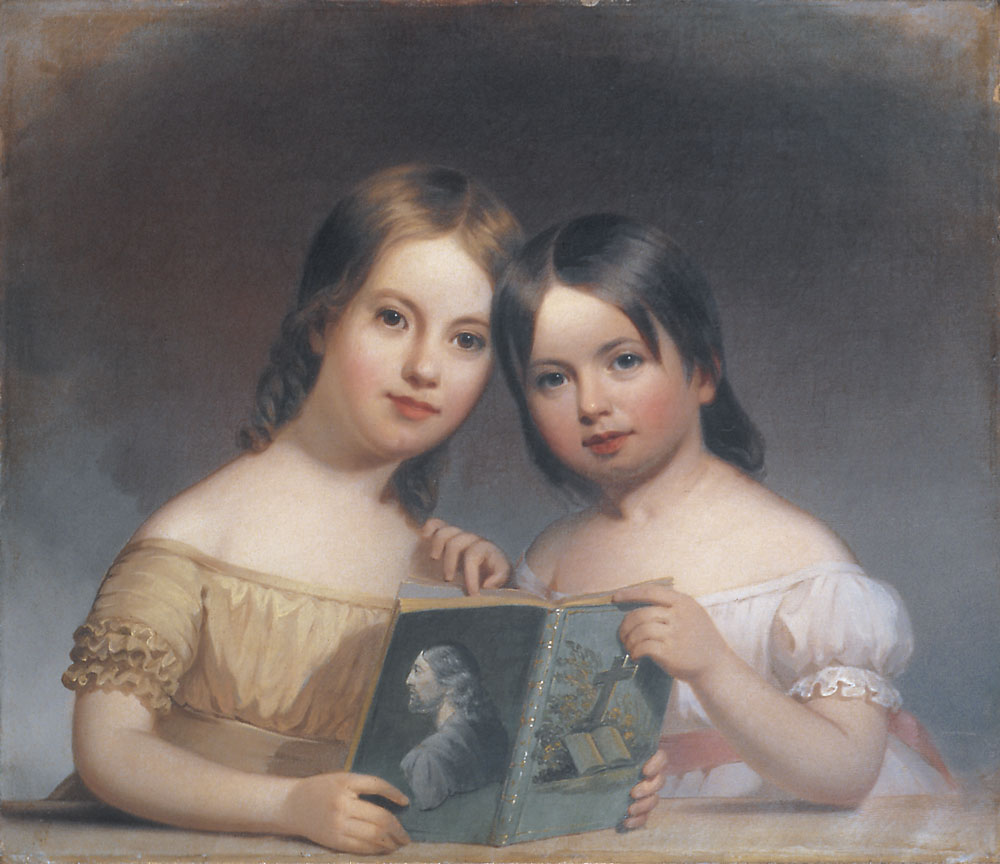
- Fig. ane: Jacob Eicholtz (1776–1842), Two Girls, Lancaster, Pennsylvania, ca. 1820. Oil on canvas. Courtesy of Lancaster County Historical Society, Lancaster, Penn.
|
|
Primitive portraits were more often than not painted past itinerant artists who worked for nutrient and lodging or who rented their facilities, staying in an surface area until all interested subjects had been painted earlier moving on. They occasionally advertised their services in newspapers, offering additional skills such as fancy, sign, and coach painting to broaden their potential for income. Some artists charged unlike rates depending on how much a sitter was willing to spend, which was reflected in whether the finished production had more or less realism and modeling. Some itinerant artists painted at a rate of ii or three portraits per solar day, providing little opportunity to correct errors or endeavour significant over-painting. About of these artists did not sign their names. When they did, information technology was ordinarily on the dorsum of the sail, with information about the sitter, location, or appointment. Equally a upshot, nearly attributions are based on rare signed examples, documents, or family histories.
-
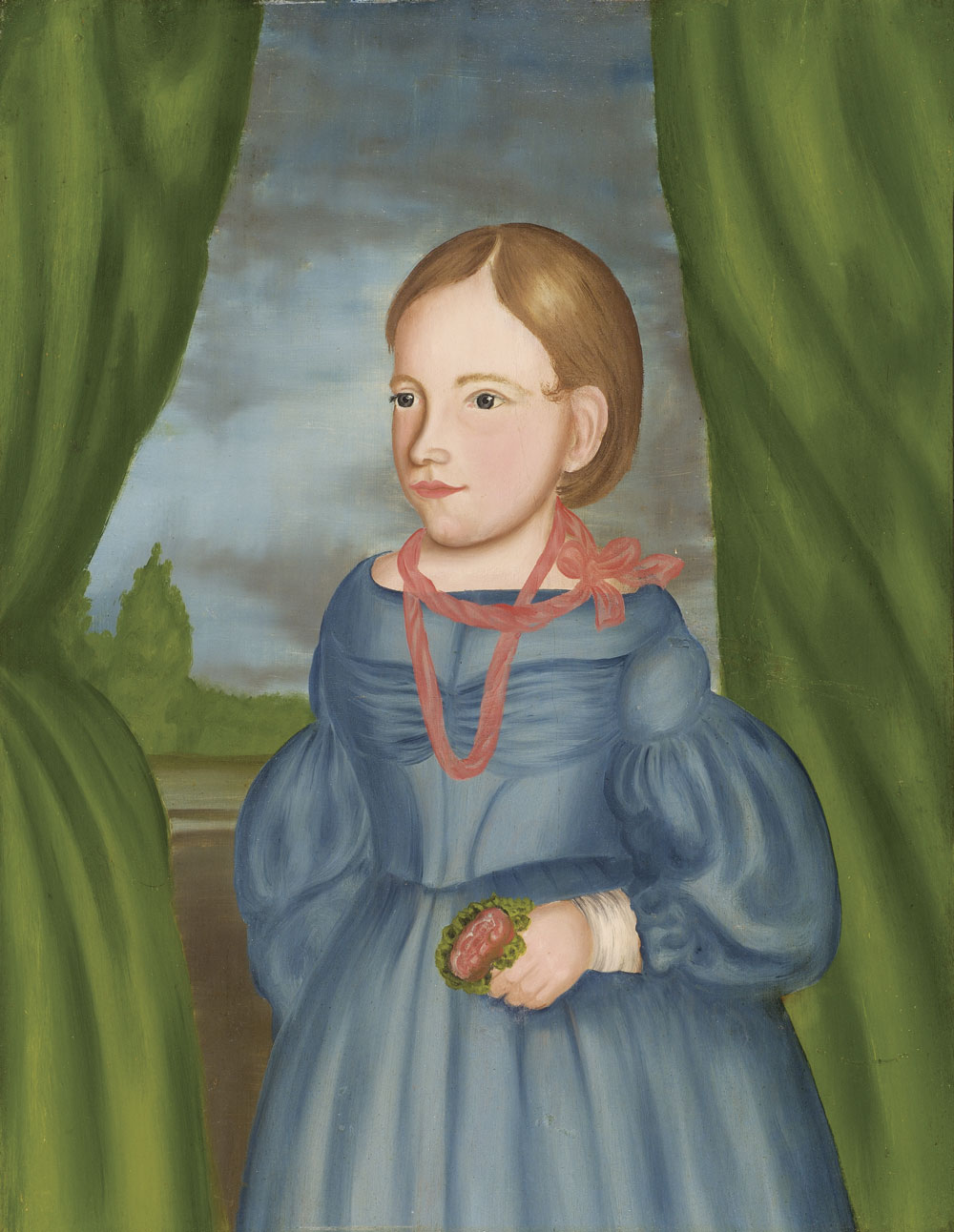
- Fig. iv: Unknown artist, Girl in Blue with Pink Ribbon, 1837. Oil on forest panel, 26-1/2 x 20-1/2 inches. Courtesy of a individual drove. Photography by David Stansbury.
Portraits past academically trained artists of this era are generally quite realistic: facial features are modeled with subtle shading, highlights, and coloring; the body is anatomically correct, with a natural pose; the perspective is accurate; and fabrics are identifiable, and backgrounds, furnishings, and accoutrements are attentively detailed. Two Girls (Fig. 1), by Jacob Eicholtz (1776–1842), is an instance of a fine "bookish" portrait. 2 This early nineteenth-century artist worked in Lancaster County, Pennsylvania, and studied briefly early in his career with Gilbert Stuart in Boston.
In contrast, primitive portraits normally show a linear format with flat facial features; a pose, frequently potent, that is turned three-quarters or is fully frontal; minimal shadowing to indicate the direction of calorie-free; simplified versions of easily, ears, pilus, and disproportionately sized heads; arms and legs extended from bodies in distorted directions; sometimes greater attention paid to details of clothing and backgrounds equally compared to the face up; backgrounds may be either apparently and free of objects and scenery or, conversely, a fanciful rendition. Though artists had varying skills, with some having small-scale academic preparation, most primitive folk portraits showroom some or all of the above characteristics.
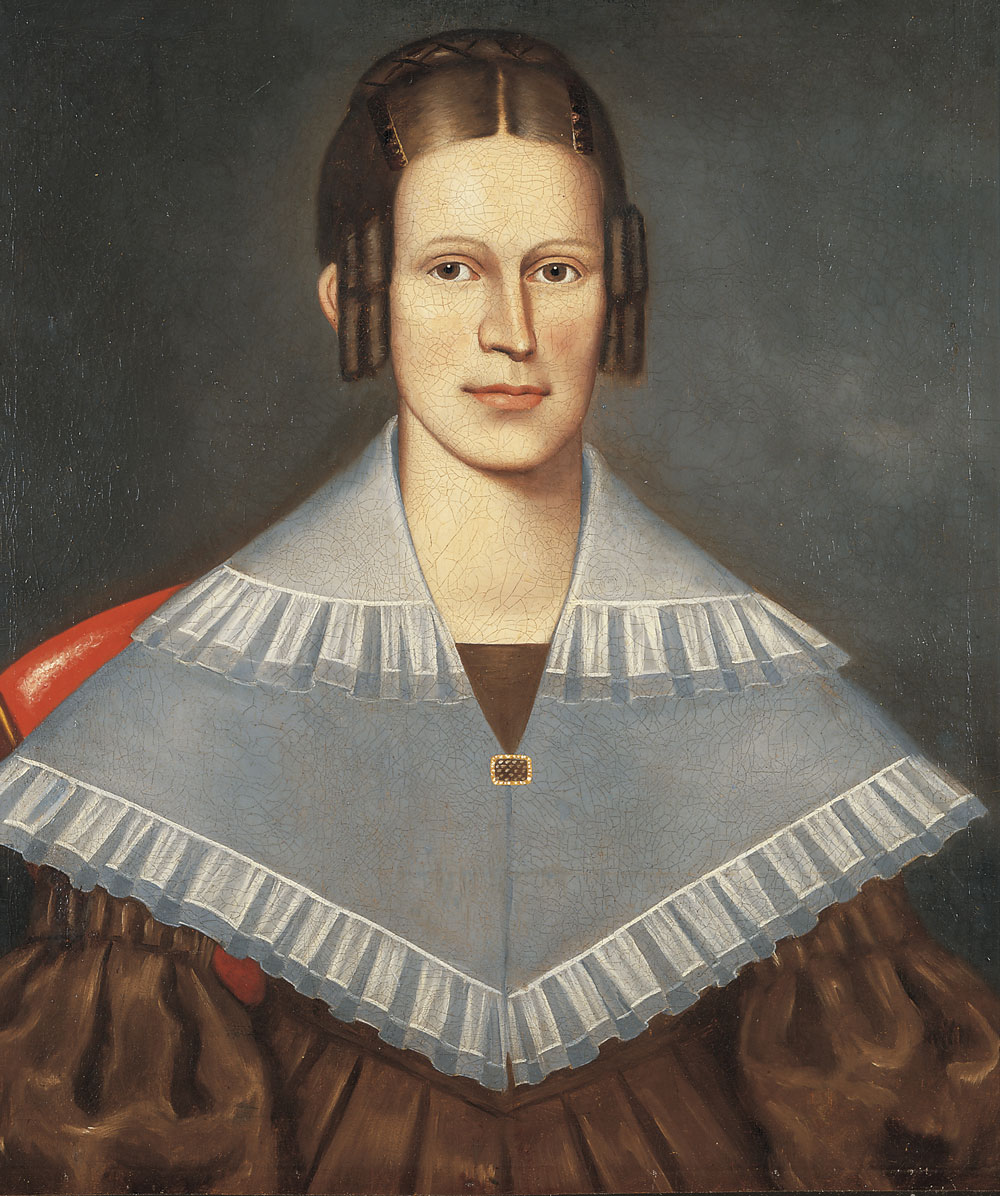
Erastus Salisbury Field (1805–1900), a portrait painter from Leverett and Sunderland, Massachusetts, produced dozens of portraits that showed beautiful effects through subtle colour changes, the rendering of gently sloping shoulders, and wear that was balanced with the overall scheme of the painting. As a youngster he showed a natural talent for sketching family unit members, and at age nineteen briefly learned the rudiments of painting from Samuel F. B. Morse, a co-founder of the National Academy of Pattern in New York Metropolis in 1825, and later, inventor of the telegraph. three The portrait of his sister-in-law Thankful Field (Fig. 2), painted in 1835, is an example of the artist at his best. Starting at the bottom, a pyramid is formed by a purplish-chocolate-brown clothes with lengthened blackish brush strokes, a simple gray pattern of lace, a graceful neck, and a well depicted face up. The hairpins and the part in her hair subtly direct attention to the face up. These elements, along with the ruffles in her shawl, create a vertical linearity. Presenting the effigy against a nighttime gray groundwork enhances the effectiveness of a pattern in which the creative person daringly uses four shades of gray for over fifty percent of the sheet. For a splash of color, Field "caught a little red" (to utilise a modern artistic colloquialism that denotes the addition of an center-catching flake of color) with the chair backside the right shoulder and below the right arm. While the subject's face is depicted mostly caput on, her olfactory organ points to the right, which reflects the naiveté of the creative person'due south rendering of physical features.
|
|
|
|
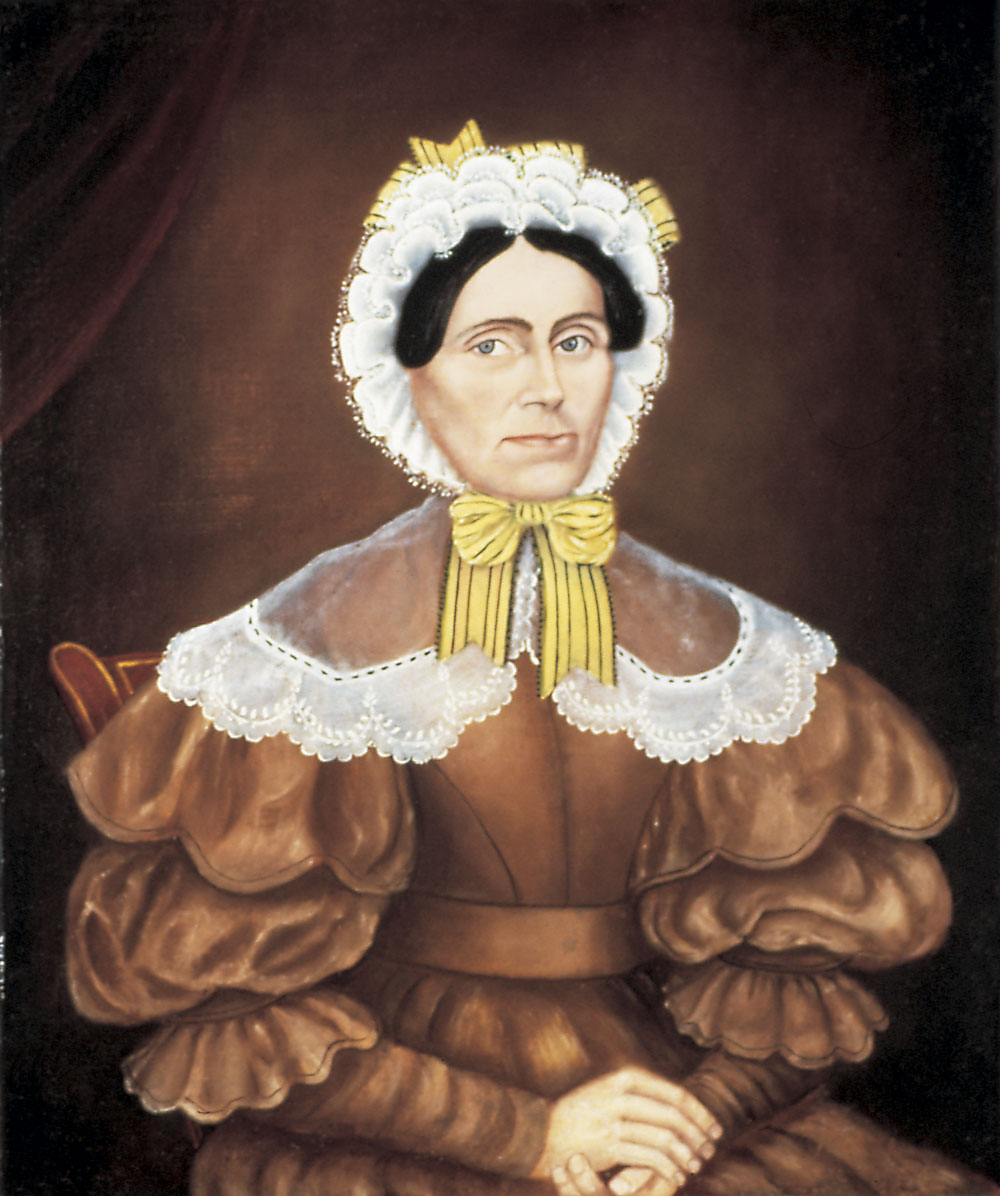
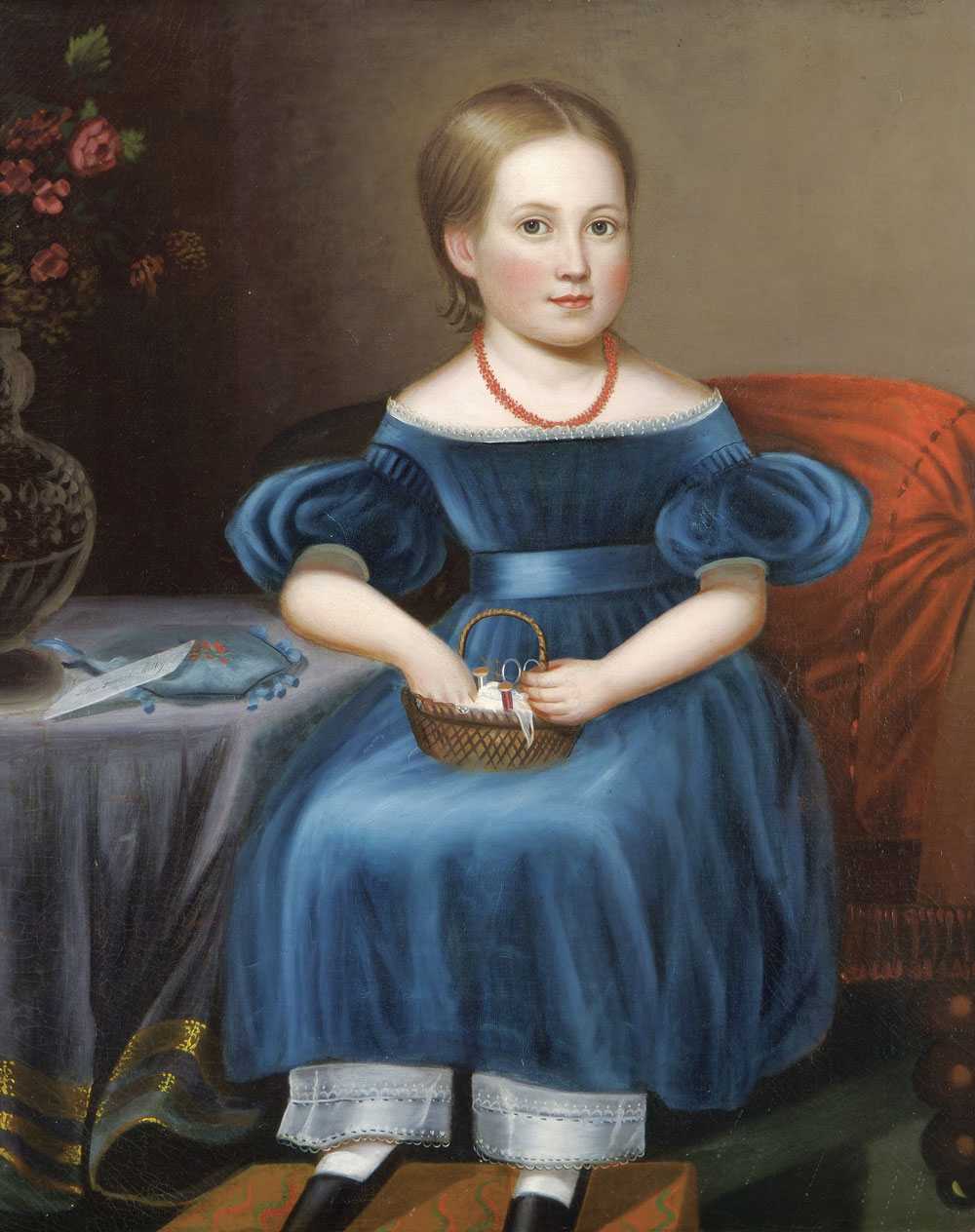
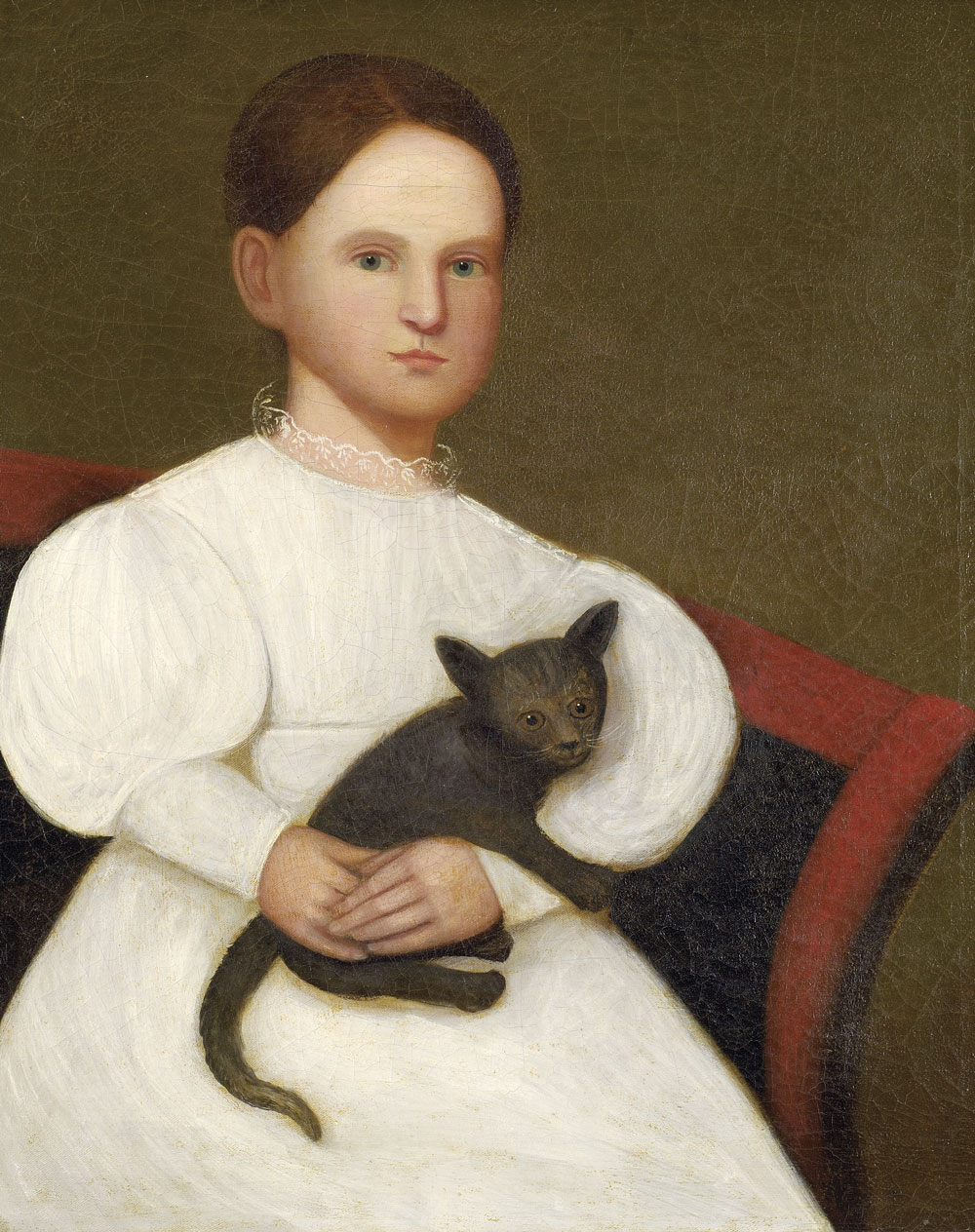
Primitive portrait painters occasionally used the aforementioned props in their images, "dressing" the sitters in the same outfits and reusing pieces of jewelry. In 1840, David Waite Bowdoin (ca. 1819–ca. 1872), an obscure portraitist (only two paintings are known) from New Braintree, Massachusetts, painted a beautiful portrait of his female parent (Fig. three). 4 Because and so few of his images have been found, information technology is unknown whether her outfit was a stock prop or if information technology belonged to her. Bowdoin may have assisted in its pick because he knew it would translate well in the image. He produced a beautiful pattern, with the bottom of the apparel flowing outward and so moving into a pyramid, enhanced past the detailed white lace on the shoulders and around the head, which frames a finely portrayed face. He used yellow ribbons as a color accent. Even and so, the abnormal depiction of the hands and lower arms, the stylized hair, and the "apartment" rendering of his subject, categorizes this image as a primitive portrait.
-
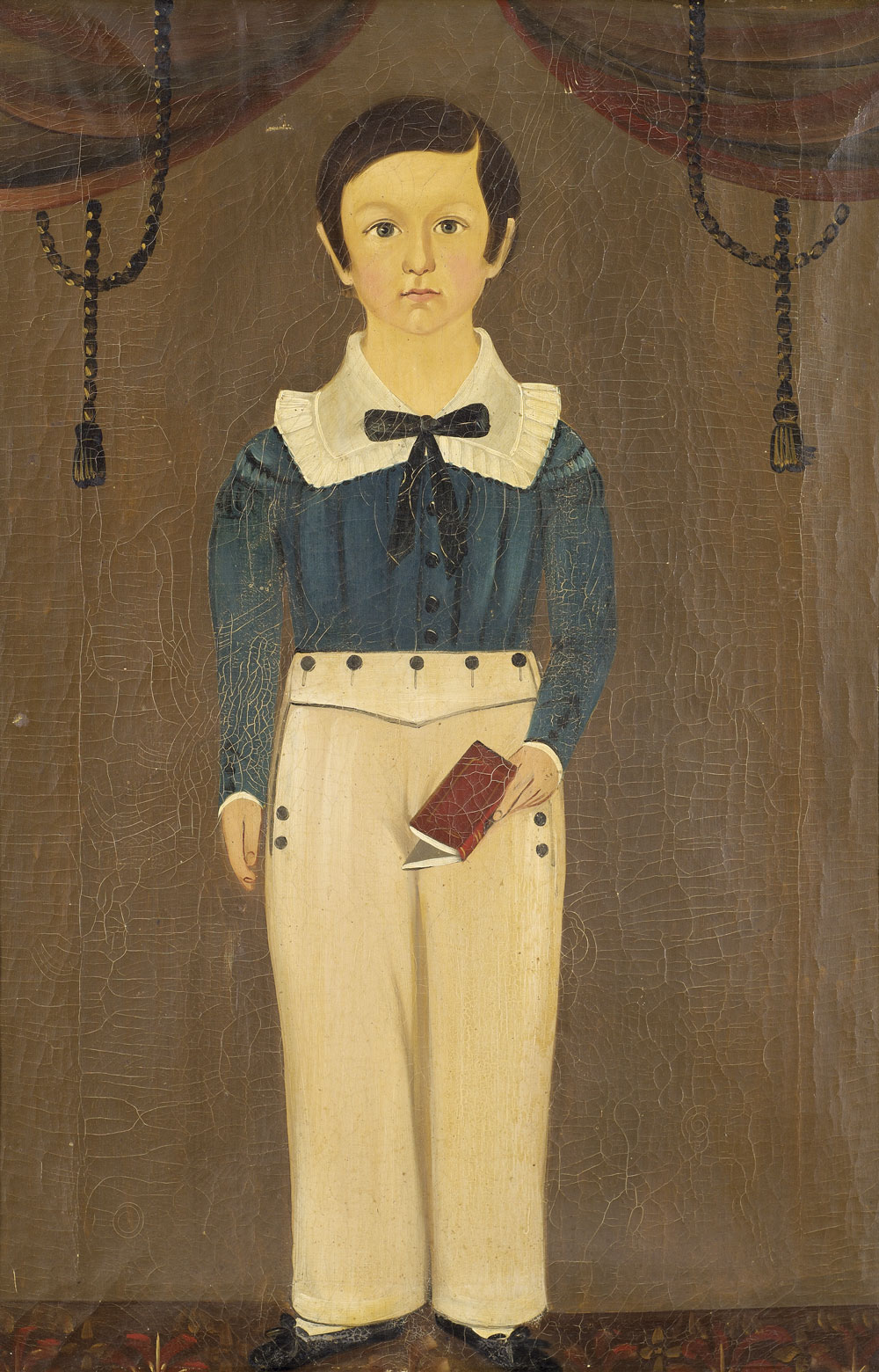
- Fig. 9: Sturtevant Hamblen (active 1837–1856), attributed, Boy in Blue and White, probably Massachusetts, ca. 1840. Oil on sheet, 36 ten 23-3/four inches. Ex-collection Clarke Garrett; courtesy of a individual collection. Photography by David Stansbury.
An unsigned portrait of a young girl, her face partly in profile, is a symphony of bluish and dark-green (Fig. four). The unknown artist used dissimilar shades of these 2 colors for the bulk of the painting, creating a design in which the girl'due south simply portrayed head stands out in a hitting manner. Attention is drawn to the head, ribbon necklace, and to the pocket-size mitt with a spot of varied colour from a crimson flower. The painting is disarmingly elementary, notwithstanding the use of very few colors is unusual and daring.
As figure 4 illustrates, many primitive artists didn't focus on extraneous details, either considering they felt they were not necessary or were not trained to recreate them. Simply some artists paid shut attention to their sitters' personal idiosyncrasies and to the background and fixtures. Among them were John Blunt (1798–1835), who worked in New Hampshire and Massachusetts, and Zedekiah Belknap (1781–1858), who painted portraits in Vermont, New Hampshire, Massachusetts, and New York. A distinguishing feature of Blunt's work was the richness of his colors (Fig. five); 5 and Belknap's was his stroke blueprint and the manner in which he positioned his subjects (Fig. six). half dozen In the portrait shown in effigy vi, employing virtually only the colour white, Belknap used brush strokes to show the roundness of the puffed sleeve and to make the sitter's skirt appear to flow downwardly to a point at the lower right.
In 1980, Tom Armstrong, former director of the Whitney Museum, noted that early on "folk artists display much greater creativity and artistic ability than they have previously been credited." 7 He was summarizing the change in appreciation and recognition of folk paintings that started in the mid-twentieth century amidst fine art historians, collectors, and dealers; works that had been admired decades earlier by modern artists. While many folk portraits are relatively crude, having been described as "ancestor paintings" until the 1960s and '70s, most of the primitive artists of the first one-half of the nineteenth century clearly had a desire to improve their abilities, which was oft reflected in their changing styles. Works past Ammi Phillips (1788–1865), Sheldon Peck (1797–1868), and Zedekiah Belknap testify how they refined their work over time, simplifying the images and irresolute their color palettes. viii Joseph Whiting Stock's (1815–1855) journal describes his experiences in learning how to use the medium of oil pigment and produce likenesses. 9 Injured and made a paraplegic at the age of eleven, he showed early talent for whittling and making toys. He tried painting portraits, and, with practice and the help of a nearby trained artist, produced a good likeness of his sisters. His friends began to commission portraits ("executed with diverse degrees of success") and his reputation spread.
Some of the most well known primitive portraits were executed by members of what has go known as the Prior-Hamblen Schoolhouse, which consisted of William Matthew Prior (1806–1873), Sturtevant Hamblen (active 1837–1856), George Hartwell (1815–1901), and others who painted in a like manner. Prior worked primarily in Maine, New Hampshire, and Massachusetts (particularly Boston). He adult variations in his fashion to arrange his sitters' abilities to pay, offering portraits that ranged from quickly produced flat images with little shading to more academic portraits with modeling and depth of style. It was the quondam that was largely emulated by artists in the Prior-Hamblin School and that many collectors consider desirable for their naive charm.
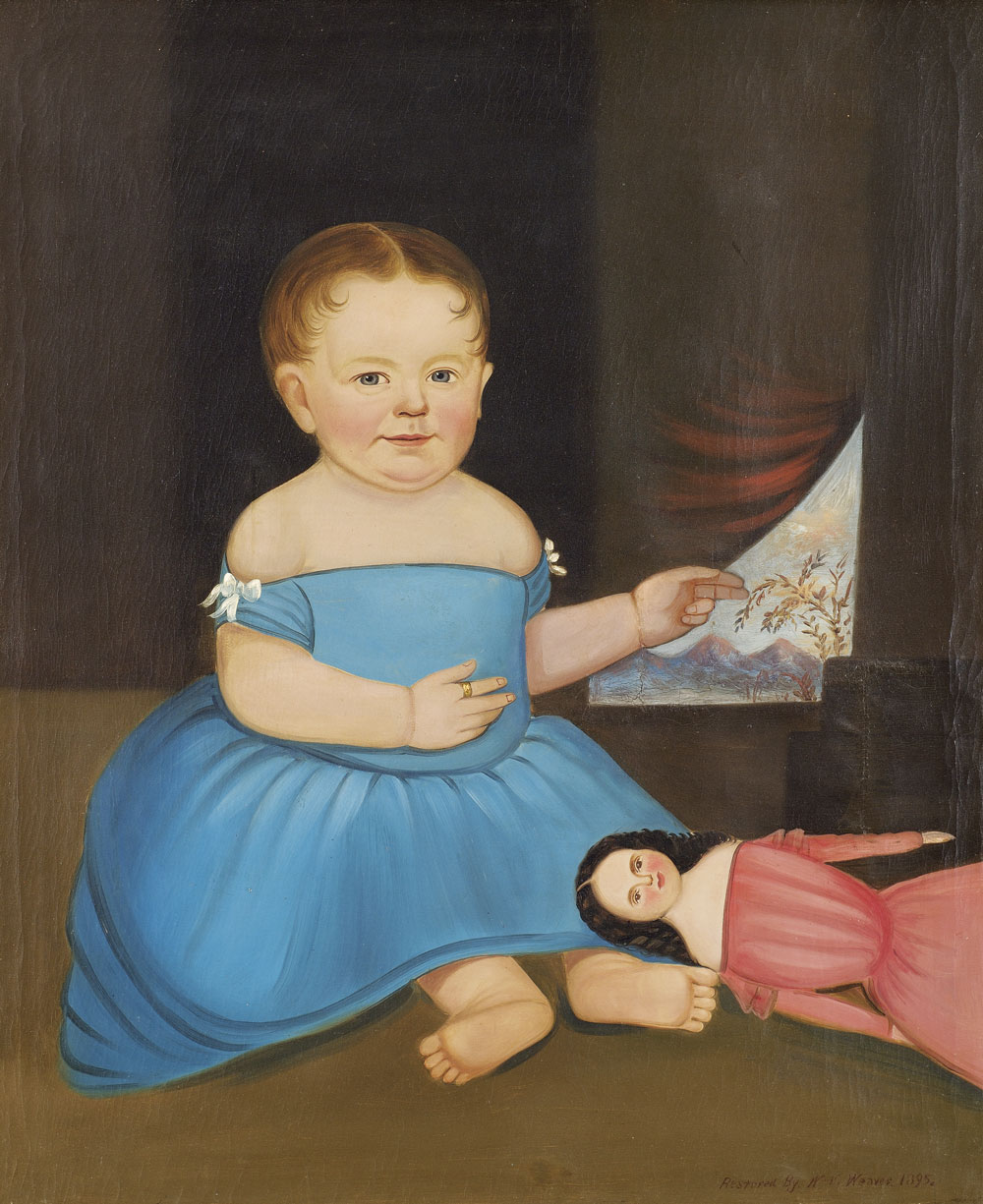
Infant in Blue (Fig. 7) is unsigned but attributed to William Mathew Prior; the stubby fingers and the nature of the brush strokes are characteristic of his work. x This painting has the "extras" prized by today'southward collectors, including the doll (which he daringly cutting off at the painting's edge) and the mountain scenery visible through the window. The curves and arcs, evident in the pilus, shoulders, and skirt, add a visual depth. The bottom edge of the doll forms a continuation of the curve of the lesser of the babe'southward brim, while the doll's top continues the line to the right side of the skirt, all providing a pleasing "flow." The long brush strokes demonstrate that Prior's technique included using his whole arm to complete his strokes, a method admired by mod artists.
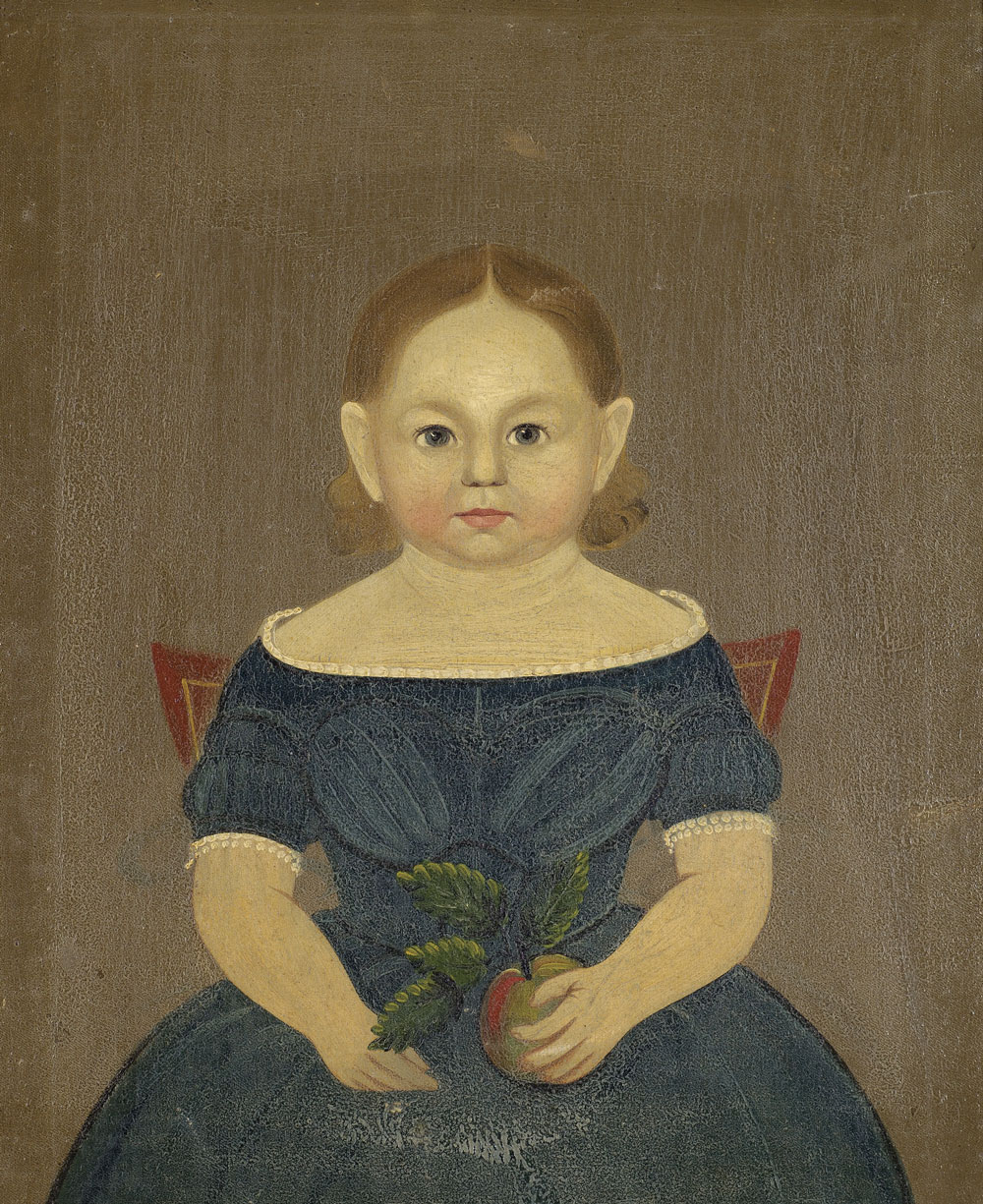
Based on signed and attributed examples, Prior was prolific. Unsigned portraits not assigned to Prior but that evidence Prior-similar similarities, are attributed to the various members of the school, depending on the characteristics. A painting of a piffling girl in blue (Fig. viii) shows a clever, orderly arrangement of angles and arcs. The pointed hand with long fingers outlined in a dark tone, oftentimes found in paintings by Sturtevant Hamblen, indicates an attribution to him. Hamblen was Prior'south blood brother-in-law and may have been his pupil. The number of his signed works is much less than that of Prior's. 11
|
|
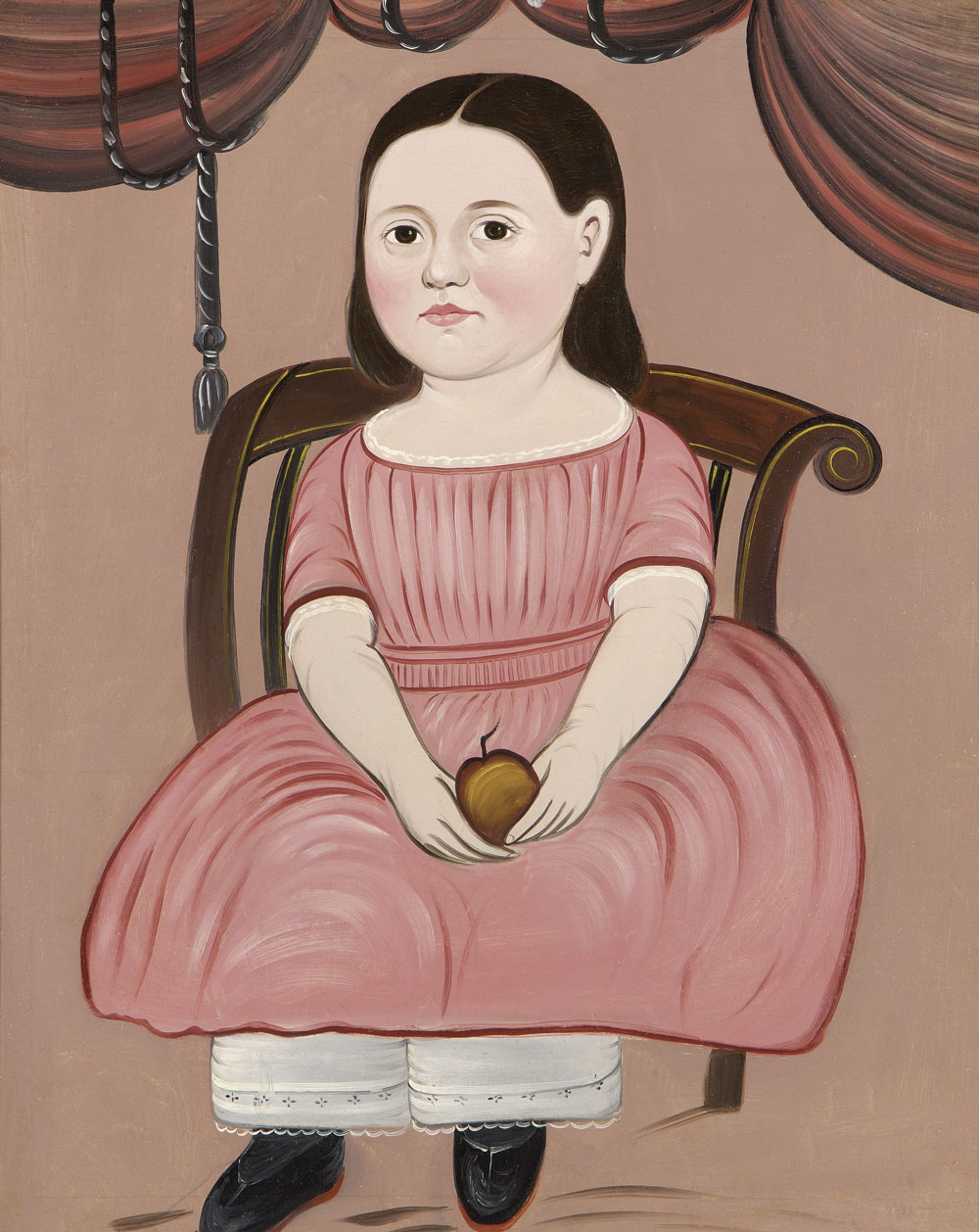
There is a remainder in the blueprint of figure 8, with its invisible downwards centerline through the part in the pilus, nose, and the folds of the bodice, one side being the obverse of the other. The ears, the chair and the waist all aim upward and outward at the aforementioned bending. The skirt arcs upward, the bodice arcs downwards, and the shoulders arc and slide pleasingly into the bodice. Using this treatment, attention is pulled to two centers of interest: the caput, for which the blank shoulders and neck create a svelte pedestal, and the apple tree. Nigh invisible in the painting is the light-colored pilus coming down below the ears, perchance deliberately so, to proceed information technology from detracting from the design. The balance of the right and left sides of the figure, forth with the stiff tapered paw and overall stiffness of the subject area, are frequent Hamblen characteristics that further enable us to aspect unsigned paintings to this artist. Hamblen used built-up dabs of white paint (impasto) for edges of the neckline and sleeves to give a sense of realism, maybe a technique he learned from "schooled" artists while living in Boston. In another Hamblen painting (Fig. 9), the prototype shows a sense of balance with a vertical stance and frontal pose seen in a number of his paintings; in this instance, giving the male child a disciplined appearance.
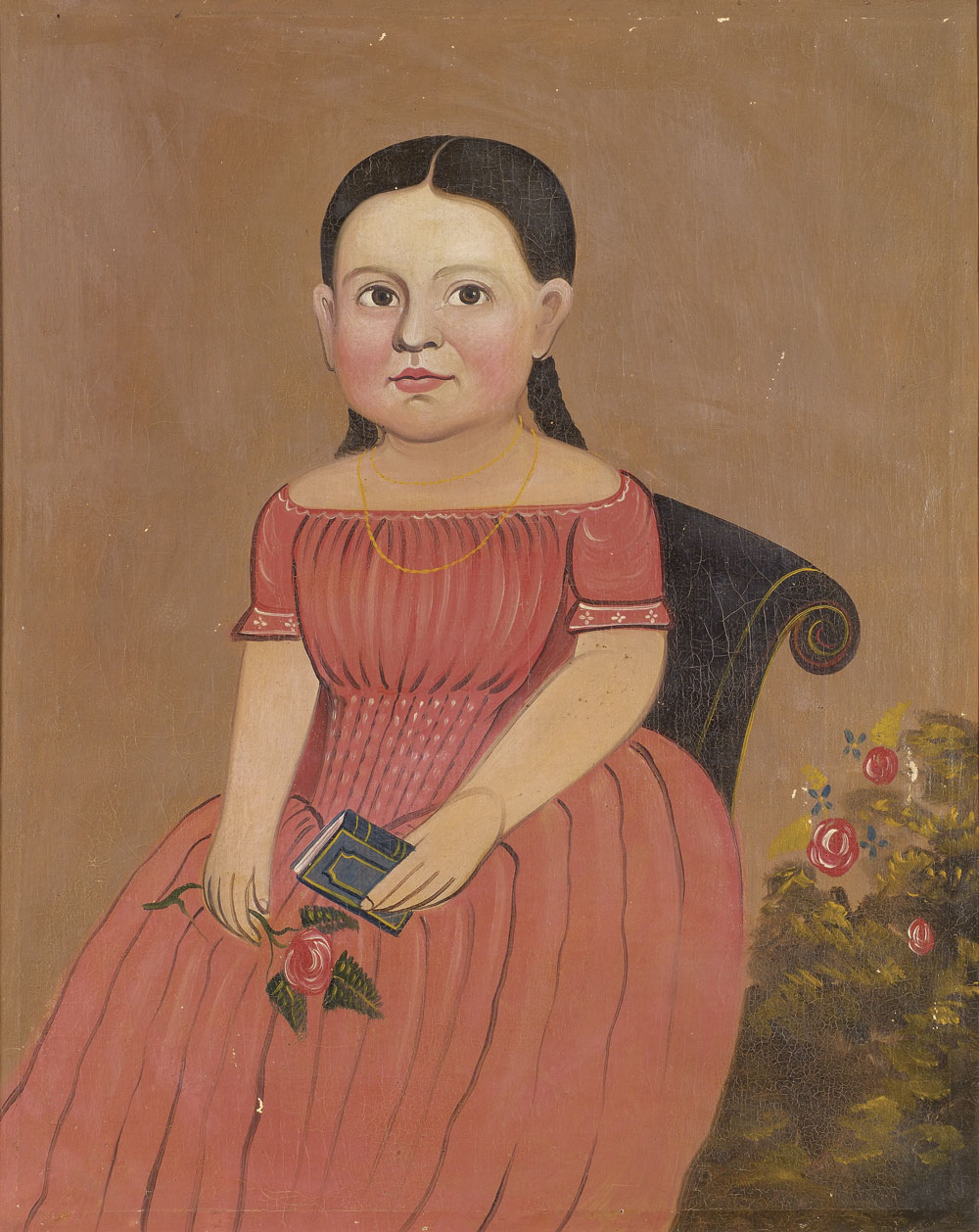
Two pleasing unsigned circa-1840 paintings of little girls in pink (Figs. x, 11) are attributed to George Hartwell, who was related to the Prior family unit by matrimony. Petty is known today about this New England artist. Paintings signed by him are distinguished from the work of other Prior-Hamblin School members by single castor-stroke curved fingers and lips delineated by a curved brownish line beyond a red field. The artist quick-stroked the girls' dresses, concentrating instead on the important part of the images, their faces.
|
|
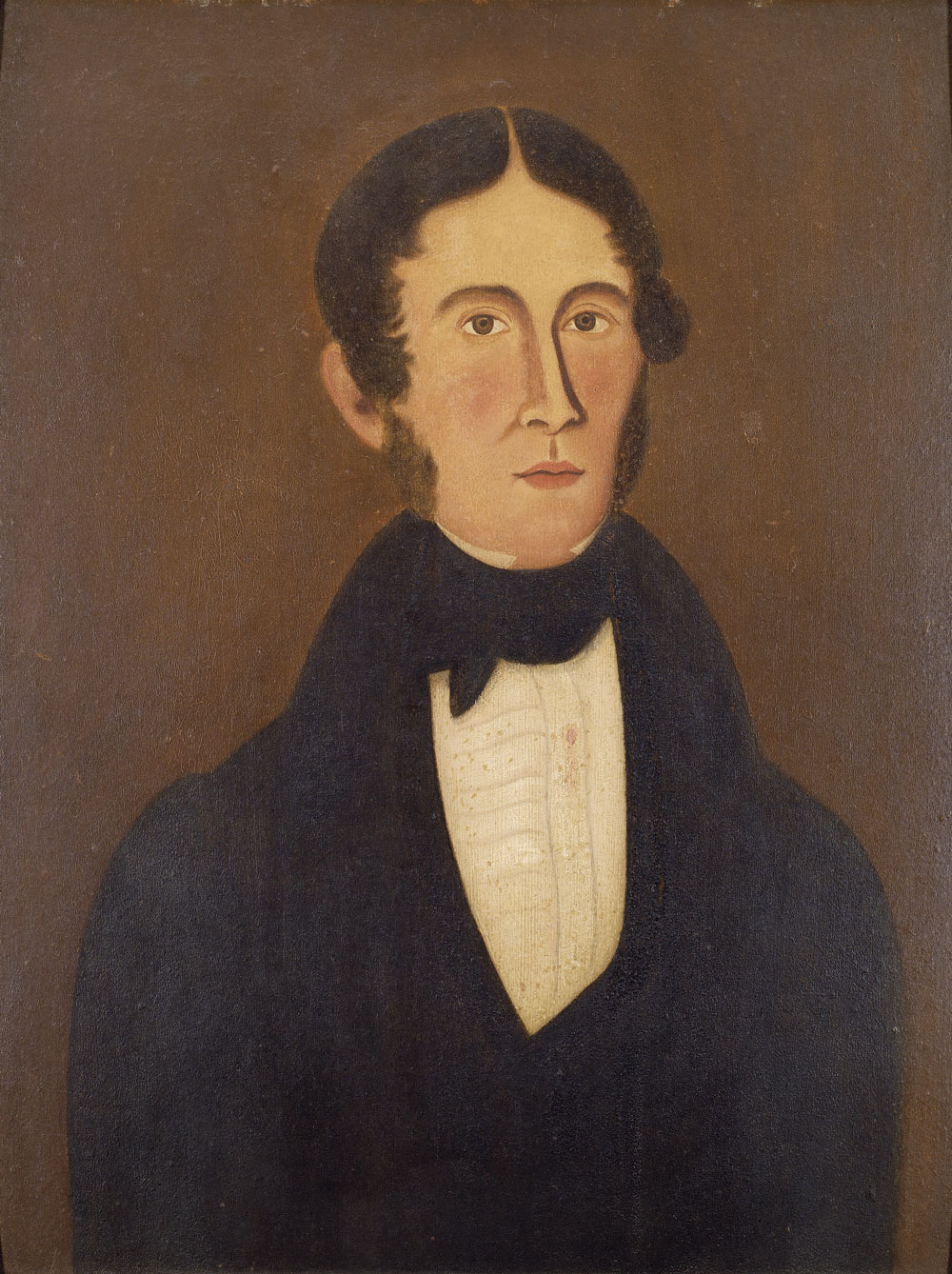
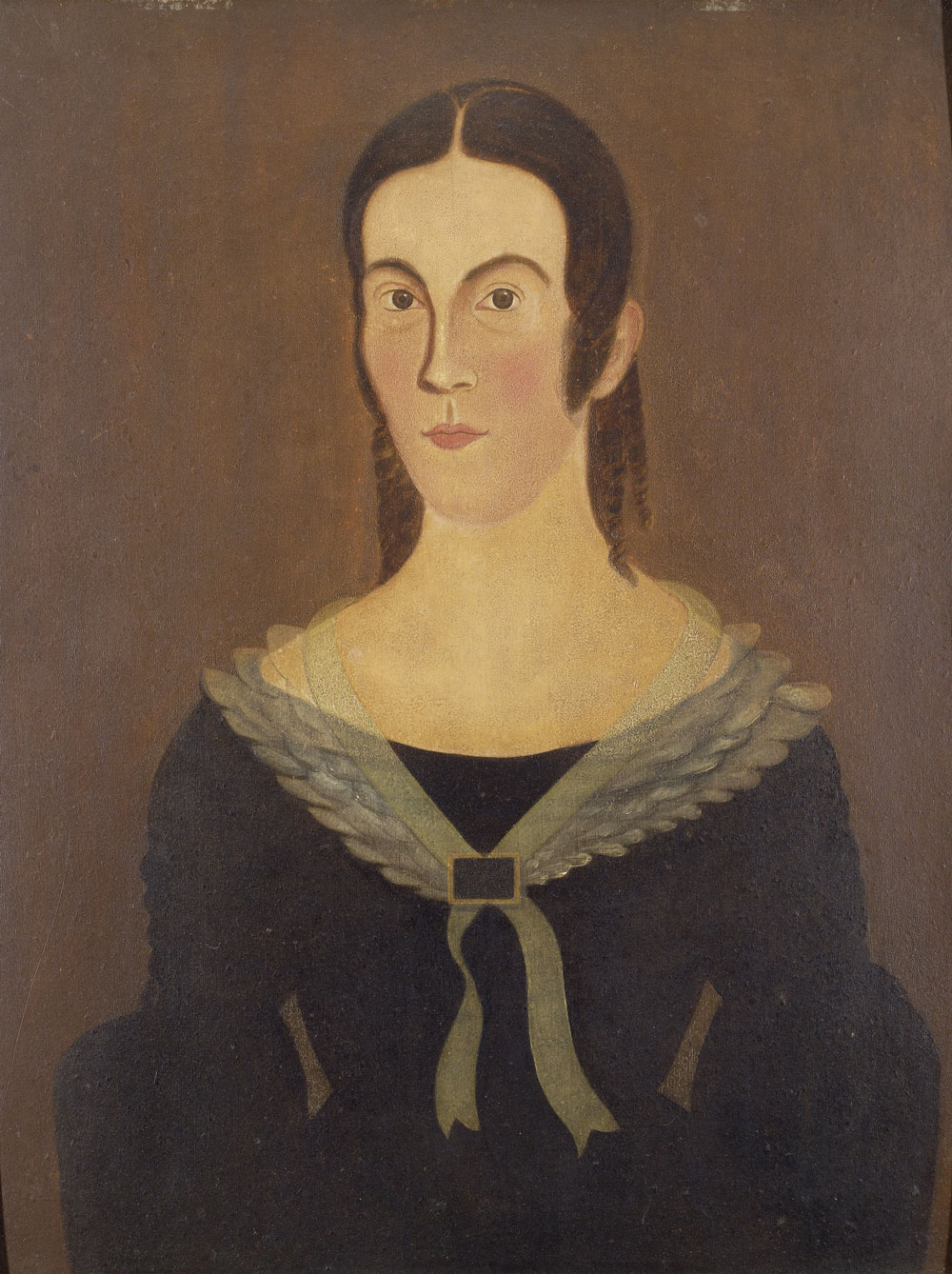
A pair of simple portraits of an unknown man and adult female are also attributed to Hartwell (Figs. 12, 13). Taken together, they are charming in their naiveté. The heads are oval, the necks long, the shoulders sloping, and the hands are not shown. The body pedestal in each is blackness. With the human on the left and the woman on the right (the way they are meant to be hung), the two paintings balance and complement each other. Their like hair parts slope toward the centerline, the shadows of the noses are each on the centerline side, and the sitters each display an ear on the side uttermost from each other; all of which create a pleasing symmetrical upshot. The description given past Paul D'Ambrosio and Charlotte Emans in Folk Art's Many Faces of some other painting, possibly by the same creative person, could equally apply to these paintings: They "illustrate the simplicity and directness that narrate the most successful folk paintings. The overall flatness and solid areas of color focus the viewer'south eye on the smooth, graceful outlines of the figures." 12
Many archaic, or folk, artists of the flow from 1800 through the 1850s were truly talented and creative individuals. Through their work they exhibited artistic expression and created a truthful original American fine art course.
David Krashes is a collector of American archaic paintings.
1. Run into Jean Lipman, American Primitive Painting (New York: Oxford University Press, 1942), 5.
2. Thomas Ryan, "Jacob Eicholtz Portrait Painter", Antiques & Fine art Mag (Bound 2003): 194.
three. Mary Blackness, Erastus Salisbury Field: 1805–1900 (Springfield, Mass.: Museum of Fine Arts, 1984), 10–11.
iv. Meet portrait of Tirzah Waite Bowdoin in Meet Your Neighbors (Erstwhile Sturbridge Village, University of Massachusetts Press, 1992), 64, 78, no. 17.
v. Dr. Robert Bishop, "John Blunt: The Man, The Creative person and His Times," in The Blaring (Spring 1980), 21.
half dozen. Elizabeth R. Mankin, "Zedekiah Belknap," in The Magazine Antiques (Nov 1976): 1064. She indicates this painting was once owned by the artist Robert Laurent and ownership passed to Paul and Marjorie Laurent.
vii. Tom Armstrong, American Folk Painters of Three Centuries (New York: Whitney Museum of American Art, 1980). Run across his Preface.
8. B. C. and L. B. Holdridge, Ammi Phillips: Portrait Painter 1788–1865 (New York: Clarkson N. Potter Inc., 1968) 11–17. See also Elizabeth R. Mankin, "Zedekiah Belknap," in The Mag Antiques (Nov 1976): 1056–1070.
nine. Juliette Tomlinson, The Paintings and The Journal of Joseph Whiting Stock (Middletown, CT: Wesleyan University Press, 1976), vi.
x. Paul D'Ambrosio and Charlotte Emans, Folk Art's Many Faces (Cooperstown, NY: New York State Historical Association, 1987), 138.
11. Ibid, 93–99.
12. Part of the description of American Madonna and Kid in D'Ambrosio and Emans, Folk Arts, 203. A painting similar to figure xiii is in the collection of the National Gallery of Art. See Lady Wearing Spectacles, creative person unknown, illustrated in Deborah Chotner, American Naïve Paintings (Washington, D.C: National Gallery of Art, in association with Cambridge University Printing, 1992), 517–518.
Source: https://www.incollect.com/articles/an-appreciation-of-nineteenth-century-folk-portraits
0 Response to "Garden Design in the 20th Century Begins With Art David Tomlinson"
Post a Comment