Some hope California’s new funding formula could ease school segregation
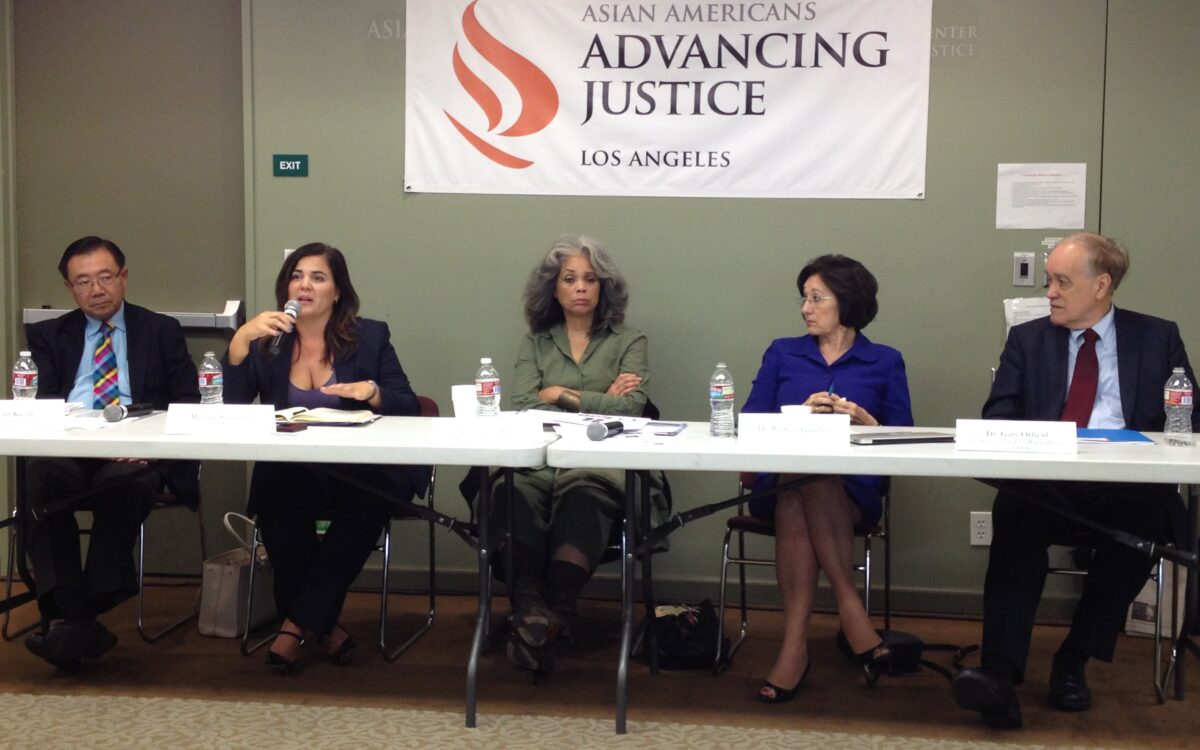 Credit: Karla Scoon Reid/EdSource Today
Stewart Kwoh, president and executive director of Asian Americans Advancing Justice-Los Angeles; Michele Siqueiros, executive director of the Campaign for College Opportunity; Constance Rice, co-founder of the Advocacy Project; Patricia Gándara, co-director of the Ceremonious Rights Project at UCLA; and Gary Orfield, co-director of the Civil Rights Project talk over the findings of a new report detailing public schoolhouse segregation in California.
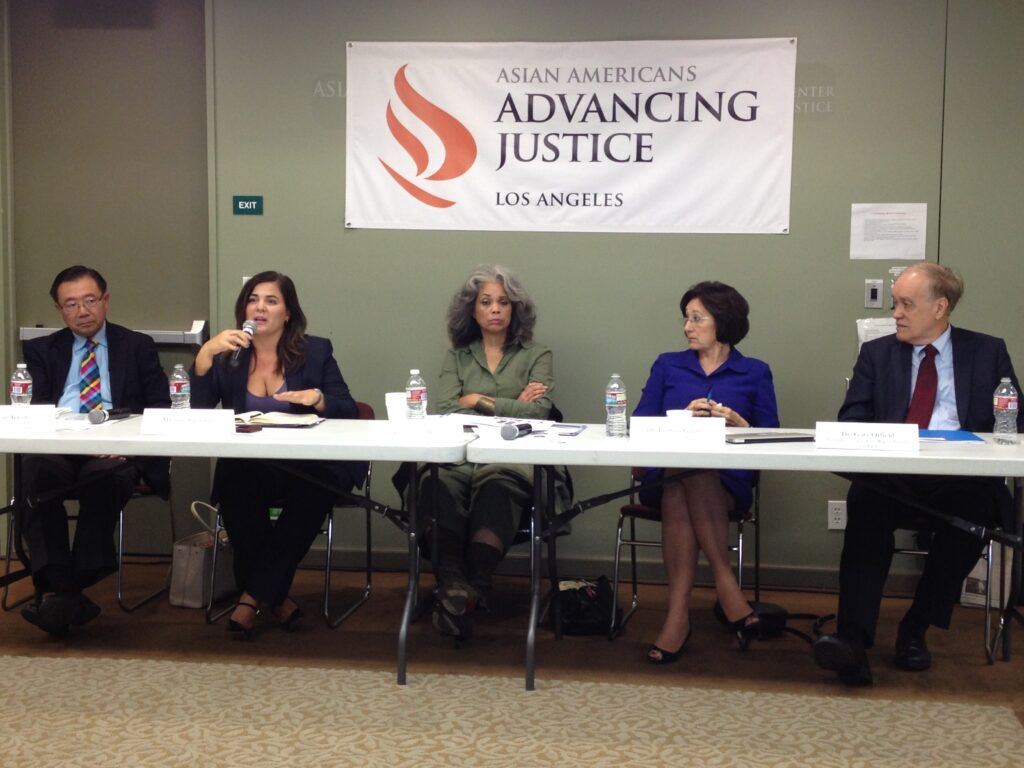 Credit: Karla Scoon Reid/EdSource Today
Stewart Kwoh, president and executive managing director of Asian Americans Advancing Justice-Los Angeles; Michele Siqueiros, executive managing director of the Campaign for College Opportunity; Constance Rice, co-founder of the Advancement Project; Patricia Gándara, co-managing director of the Civil Rights Projection at UCLA; and Gary Orfield, co-director of the Civil Rights Project discuss the findings of a new report detailing public school segregation in California.
LOS ANGELES – California's new school funding formula may concord hope for education and civil rights advocates seeking to opposite the increasing segregation of the state's schools and students.
Patricia Gándara, co-director of the Civil Rights Projection at UCLA, said the school funding law could spur activity around school desegregation, which has had few vocal champions in recent years. School districts at present have the funds and the flexibility needed to help combat racial isolation in their communities, she said.
The Local Control Funding Formula allows schoolhouse districts, with community and staff input, to decide what programs it will implement for its students. The law as well grants additional coin to improve services for loftier-needs students – low-income pupils, English language learners and foster youth. Each district must develop a Local Control and Accountability Plan that details how information technology is spending state dollars to boost services for those students. Gándara said she was disappointed that racial integration was not identified as one of the priorities districts must address in their accountability plans.
The potential of the state'due south school funding law to assistance integrate the state's schools was discussed during a two-60 minutes media briefing May 22 virtually a new UCLA Civil Rights Project report that highlights the extreme racial imbalance in California'southward schools.
The report, "Segregating California'south Time to come," examines the "triple segregation" of students who are in schools that are overwhelmingly poor, blackness or Latino, and take large numbers of English learners. (Read EdSource Executive Director Louis Freedberg'due south commentary for more details near the written report.) The New America Media conference was held at the headquarters of Asian Americans Advancing Justice-Los Angeles.
"Now is the time to think about how to use that coin and other resource to make California schools less carve up and more equal," the report states.
Gary Orfield, co-director of the Ceremonious Rights Project and co-author of the report, said districts could invest in creating high-quality schools that would attract a diverse student enrollment rather than supporting choice programs, like some charters, that exacerbate existing school inequalities. The study calls for options to allow students currently enrolled in segregated schools to nourish magnet schools or academically potent schools exterior of their communities. These students should be provided free transportation to those schools equally well, Orfield said.
Co-ordinate to the written report, schoolhouse districts should use the money allocated in the Local Control Funding Formula to "assistance address some of the inequalities that face students in these unequal and separate schools while likewise expanding their real choices."
Seeking A 'Game Modify'
Orfield said the percentage of nonwhite schools – those where 90 to 100 percent of the students are racial or ethnic minorities – has more doubled in California since 1993. He added that the typical African-American and Latino pupil attends schools that are predominantly poor.
The report also examined the presentlyhoped-for-revamped Academic Performance Index (API) listings, which measure out school performance. It found that twoscore percent of white students and well-nigh l percentage of Asian students (not including Pacific Islanders or Filipinos) attended schools in the pinnacle two decile ranks. Conversely, merely 12 percent of blackness students and 9 pct of Latino students were enrolled in the state's best schools, according to the API decile rankings. The Civil Rights Project will release a report in Baronial detailing best practices to meet the needs of English language learners.
"This is very high stakes," Gándara said. "Center course and upwardly mobile parents chose their schools based on these scores."
While Orfield believes Los Angeles attracts diverse families, they are not sending their children to the city's schools; they're opting for private schools instead. That'south where school districts' accountability plans tin make a difference, he said.
Michele Siqueiros, executive director of the Campaign for College Opportunity, said the accountability plans could exist crucial in preparing more African-American and Latino students for college. She said many high-needs students have trivial to no chance of seeking a university degree because some of their schools don't offer the college-required curriculum, something that the accountability plans could address.
Meanwhile, Constance Rice, co-founder of the Advocacy Project, a civil rights organization, lamented the lack of political will and the limited legal avenues bachelor to face the stark racial, language and economic divisions facing the state's public schools. She suggested that instead of dwelling on "these pathetic patterns that persist decade in and decade out," that the focus should be on encouraging kids of different races to interact meaningfully with one another. Rice, for instance, talked about creating multi-ethnic able-bodied and academic teams across school and district boundaries.
"It's time for a game modify politically," Rice said. "Nosotros need to change the politics so that the solutions that we know work go done."
Karla Scoon Reid covers Southern California for EdSource.
To get more reports similar this one, click here to sign up for EdSource'due south no-price daily email on latest developments in education.
Source: https://edsource.org/2014/some-hope-californias-new-funding-formula-eases-school-segregation/62573
0 Response to "Some hope California’s new funding formula could ease school segregation"
Post a Comment